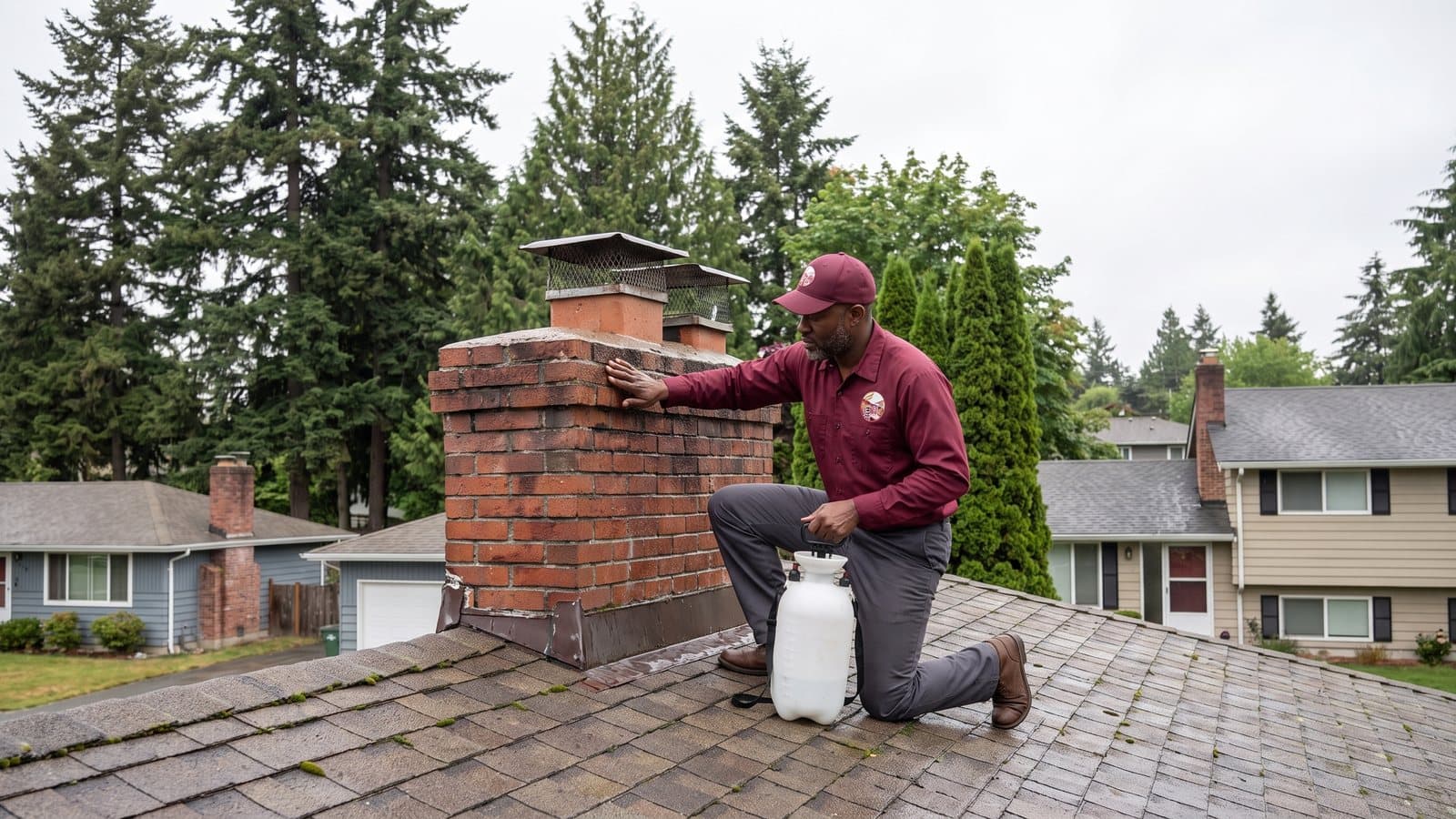
A water repellent is worth applying to a brick chimney in Renton when three things are true: the brick is absorbing rain, the crown, joints and flashing are already sound, and the masonry is dry on the day of the work. Miss the first and you are paying for nothing. Miss the second and the leak continues. Miss the third and the product does not bond. The rest of this article takes those three conditions one at a time, with the local weather record behind each.
Condition one: the brick is taking in water
Brick looks solid and behaves like a very slow sponge. How much it drinks depends on how it was fired and how weathered its face is. Some chimneys shed rain for decades. Others darken within a minute of a shower and stay dark long after the driveway has dried.
The local record explains why absorption matters here more than in a drier region. Renton's hazard mitigation annex puts the city at 38 inches of rain a year, falling on 154 days. November, December and January each bring about 6 inches. And it is not only the rain: in January, the Western Regional Climate Center reports, relative humidity across western Washington hovers near 87 percent in the small hours and has dropped only to about 78 percent by late afternoon, while a typical winter month sees the sky clear, fully or in part, on no more than four to eight days. Wet brick in that air does not dry. It waits for the next front.
Shade makes it worse. The same annex mentions Renton neighborhoods that stand wholly inside tall timber, and the one for Newcastle describes many homes backing onto dense native growth. A chimney under a fir canopy gets little sun and less wind. Oregon State University Extension points out that moss depends on shade as well as moisture, which is why a green north face is a fair sign that the masonry behind it rarely dries.
Condition two: the real leaks are already closed
A repellent lines the pores of brick and mortar so that liquid water beads on the surface. It does not fill a crack, bridge a missing joint or seal metal to masonry. Three parts of the chimney have to be right before it goes on.
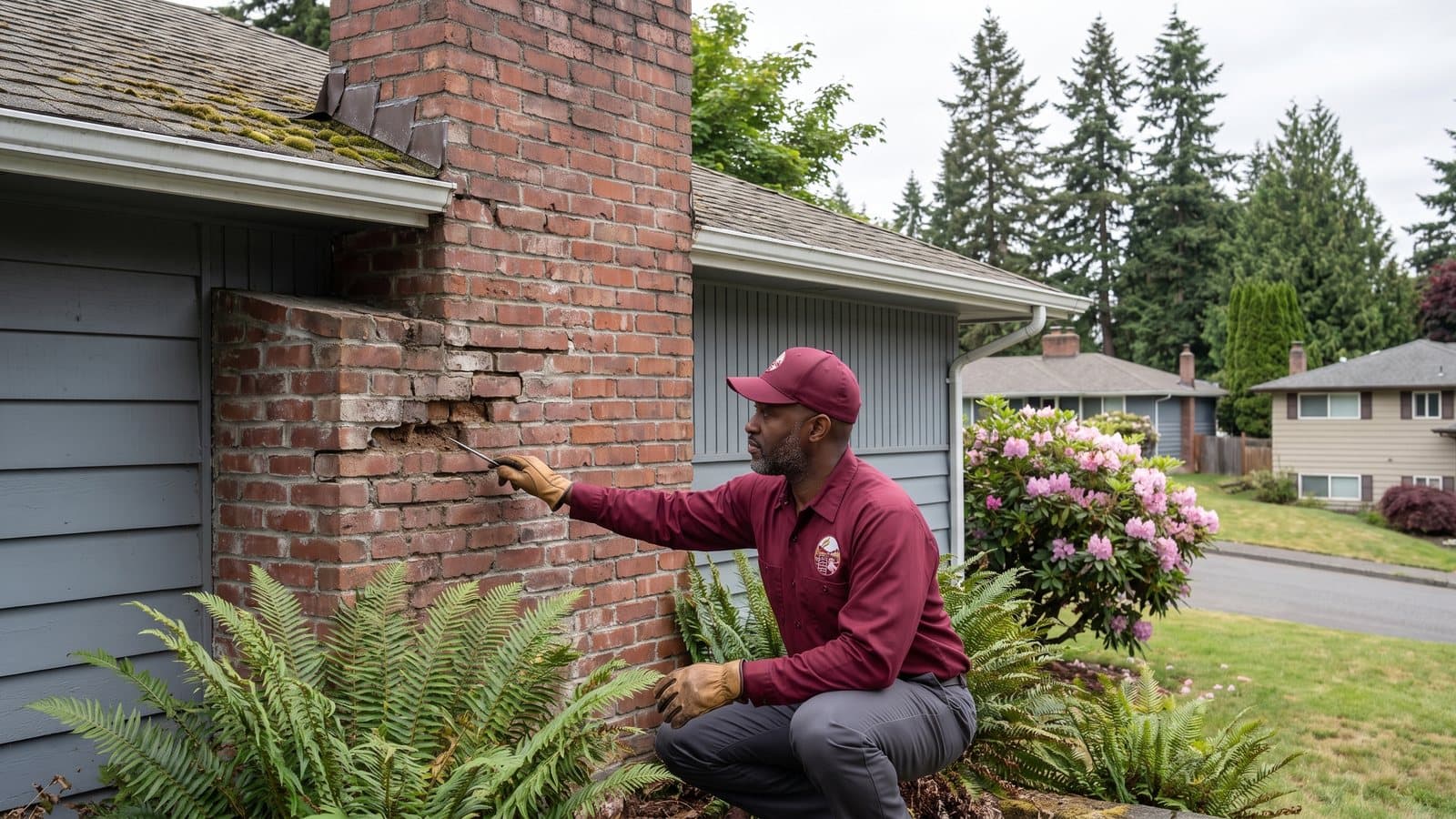
The crown. Under Washington's 2021 residential code a masonry chimney must finish in a cap of concrete, metal or stone that is pitched to shed rain, carries a drip edge and is sealed, with a bond break, where the flue liner comes through. Many older stacks have only a thin wash of mortar up there, and once it cracks, rain goes straight into the core.
The joints. Receded or sandy mortar is repointed first. New mortar then needs time to cure before any treatment is applied over it.
The flashing. At the roof line, metal flashing and a bead of sealant are what stop rain from running into the attic. No product brushed onto brick will fix a lifted flashing.
Treating a chimney with any of these open is not harmful, but the good brick ends up protected while the leak carries on. We would sooner tell you that before the job than after.
Condition three: the calendar
Masonry has to be dry through its depth to accept a repellent, and it needs dry weather for the hours that follow. In this climate that turns the job into a question of dates. The table follows the year, using the rainfall figures of the Renton and Snoqualmie hazard annexes where they give one.
The practical consequence: a call in spring gets you a summer slot, with room for a crown or joint repair to cure first. A call in October usually means the treatment waits for the following summer, and only the repairs that cannot wait are done before winter.
| Time of year | What the weather is doing | What to do with the chimney |
|---|---|---|
| July and August | Under an inch of rain in each month in Renton | Best window: repairs cured, repellent on dry brick |
| September to mid-October | Dry spell ending; the foothill wet period opens mid-October | Last dependable dates, weather permitting |
| November to January | About 6 inches of rain a month | No application; note stains and dark brick |
| February to May | Brick still wet from winter | Inspection, quote, book the summer work |
| June | Drying begins | Crown and joint repairs, so mortar cures in time |
Lake level, plateau, foothills: not the same rain
Our service area climbs from Lake Washington toward the Cascades, and rainfall climbs with it. Renton's annex gives 38 inches a year. Snoqualmie's 2020 annex reports 61.25 inches a year since 1931 at an elevation of 410 feet, with about two-thirds of it arriving between mid-October and late February, and 11.5 inches of snowfall between November and April.
So a brick chimney in Snoqualmie or on the wooded lots around Maple Valley faces a longer soak than one on the flat ground near the lake, and its dry window is shorter. The treatment is the same; the scheduling margin is not.
Why a breathable product, and never a sealer
A chimney takes in moisture from inside as well as outside: flue gases carry water vapor, and so does the air of the house. That moisture has to leave through the masonry. Repellents in the silane and siloxane family let vapor pass outward while stopping liquid water from entering, which is the whole point.
Film-forming coatings do the opposite. Paint, clear acrylic sealers and roofing compounds close the surface, moisture gathers behind them, and when it freezes the brick face comes away with the coating attached. Renton's annex notes that several days of freezing temperatures are not uncommon in winter, so this is not a theoretical risk here.
What the treatment runs with us
Waterproofing a chimney with us runs $320 to $795. How tall the stack is, how many of its four sides rise above the shingles, and the amount of washing the brick calls for beforehand decide where a given chimney lands. Crown, joint or flashing repairs are quoted on separate lines so you can see what each part of the job is. As a countrywide reference only, Fixr reports $150 to $500 nationally for sealing a chimney; that figure is not a local one and not our quote.
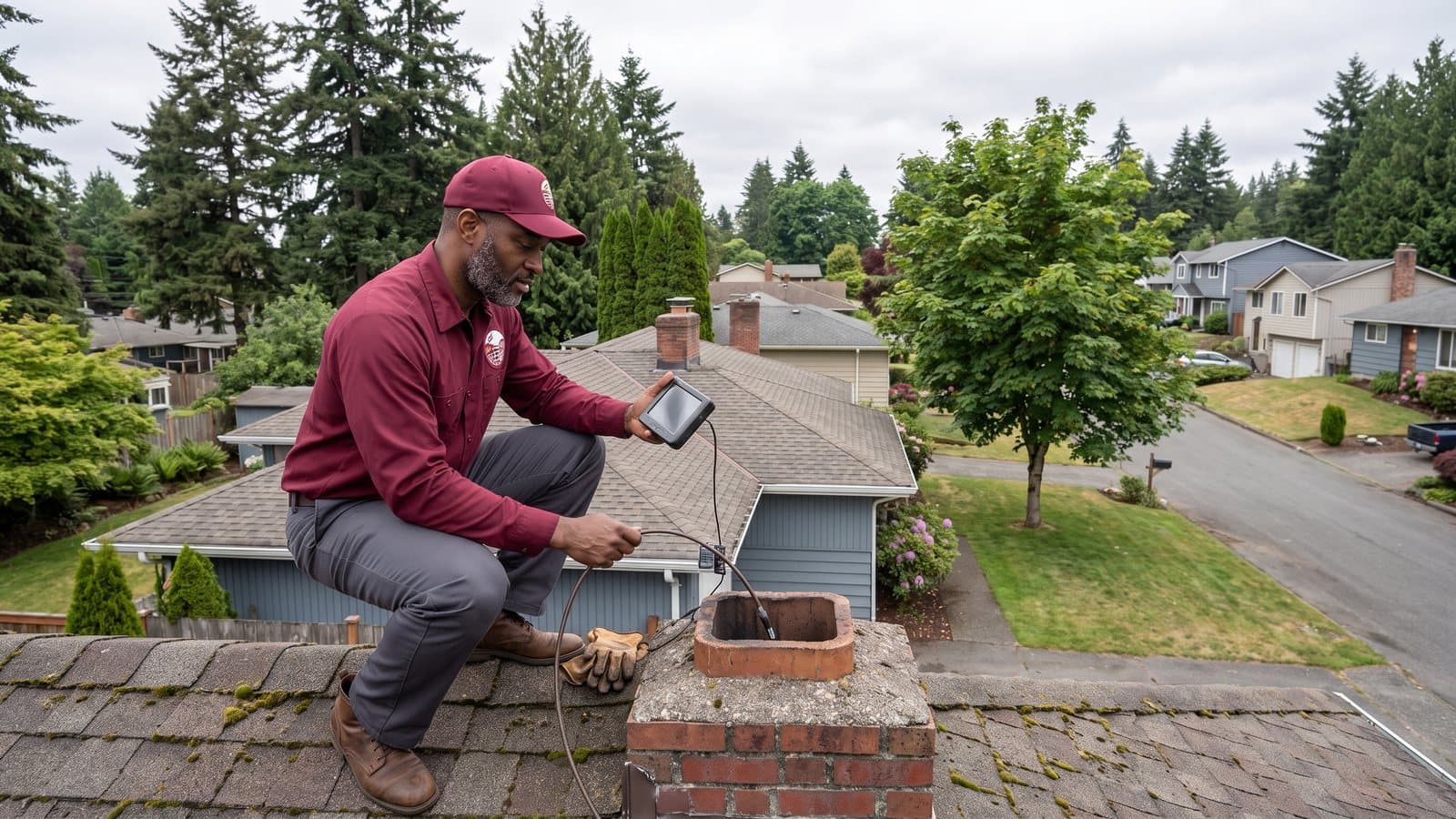
It starts with a visit to look at the chimney from the roof, $99 plus tax. Approve the quote and the $99 is deducted from the work.
Frequently asked questions
Does a water repellent change the color of the brick?
A breathable repellent of the kind we apply dries clear and leaves no film or gloss. The brick may look slightly darker for a day or two while the carrier evaporates. If a product leaves a shiny skin on the surface, it is a sealer, and a sealer is the wrong thing to put on a chimney.
My chimney is painted. Can it still be treated?
Not over the paint. A repellent has to soak into bare masonry, and paint blocks it. Paint also traps moisture behind it, which is why painted chimneys so often shed their brick faces. We look at how well the paint is holding and what the brick underneath is doing before recommending anything.
Is waterproofing useful on a framed chase with siding?
No. A factory-built fireplace in a wood-framed chase has no brick to treat. Its weak points are the metal chase cover on top, the storm collar around the pipe and the flashing where the chase meets the roof. Those are the parts we check on that kind of chimney.
The ceiling near my fireplace is stained. Will a repellent stop it?
Probably not alone. A stain on the ceiling or high on the wall usually comes from the flashing or the crown, and a repellent closes neither. The visit finds the entry point first. Treating the brick comes after that repair, as the last step.
Sources
- King County hazard plan — Renton annex — accessed October 4, 2026
- City of Snoqualmie — 2020 hazard annex — accessed October 4, 2026
- City of Newcastle — plan annex (2020) — accessed October 4, 2026
- Western Regional Climate Center — state climate — accessed October 4, 2026
- Oregon State Extension — moss on roofs — accessed October 4, 2026
- Washington Residential Code 2021, ch. 10 (UpCodes) — accessed October 4, 2026
- Fixr — chimney repair guide (national) — accessed October 4, 2026
Related services