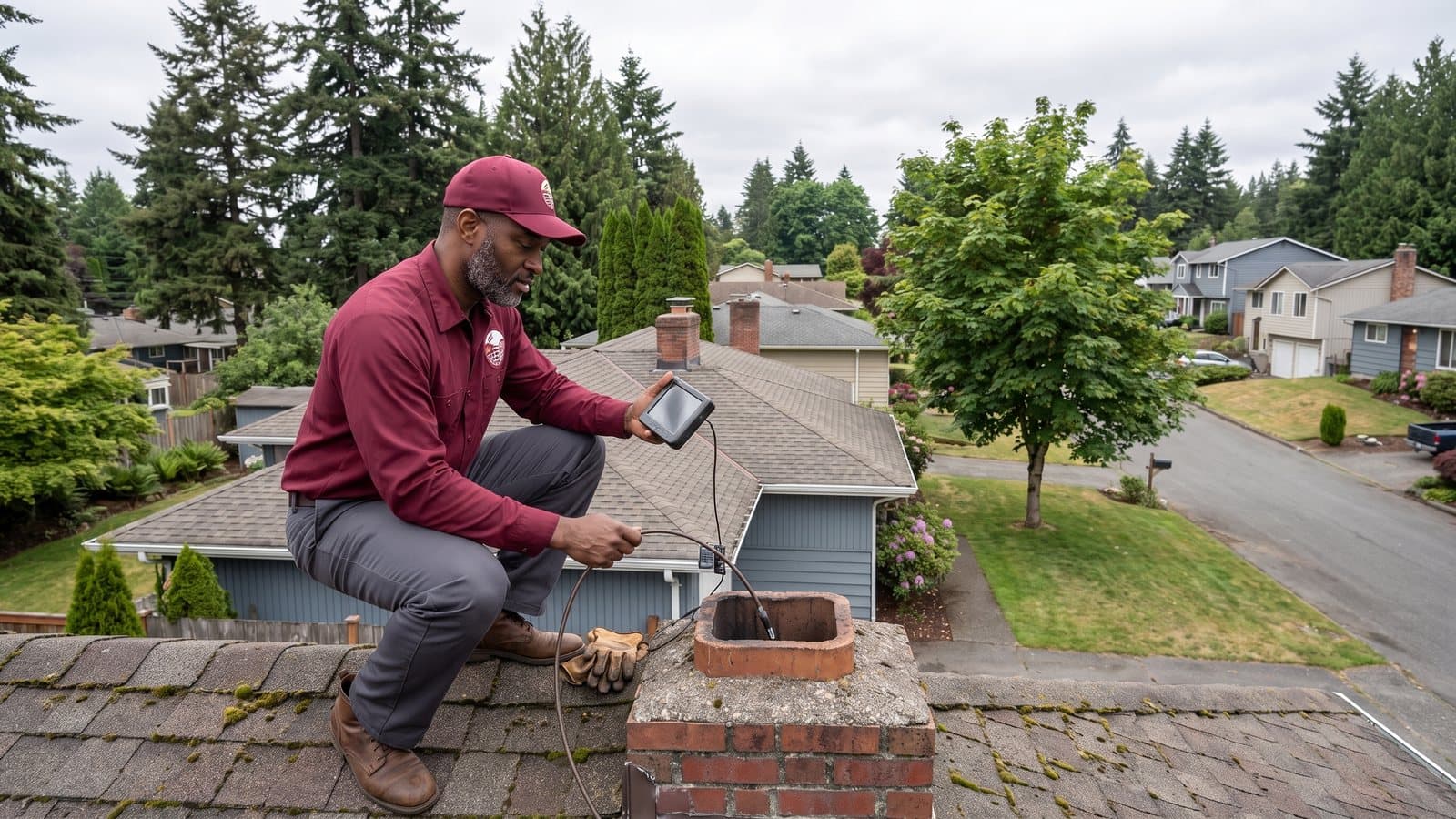
Short answer: a chimney needs relining when its flue can no longer hold heat and exhaust inside the masonry, or when the appliance connected to it has changed and the old flue is now the wrong size. Neither condition shows from the living room. Both are found with a camera. This guide lists the findings that lead to a reline, explains why Renton has more candidate chimneys than its newer neighbors, compares the liner types, and closes with our own figures.
What the liner is there to do
A masonry chimney is a brick shell built around a flue. In most houses that flue is a stack of clay tiles, each roughly two feet tall, set one on the next with a mortar joint between them. The tiles have three jobs. They hold the heat of the fire away from the brick and from the wood framing the chimney passes on its way up. They keep smoke, water vapor and the acids in exhaust out of the mortar. And they give the gases a smooth passage of a known size, which is what lets the chimney draw.
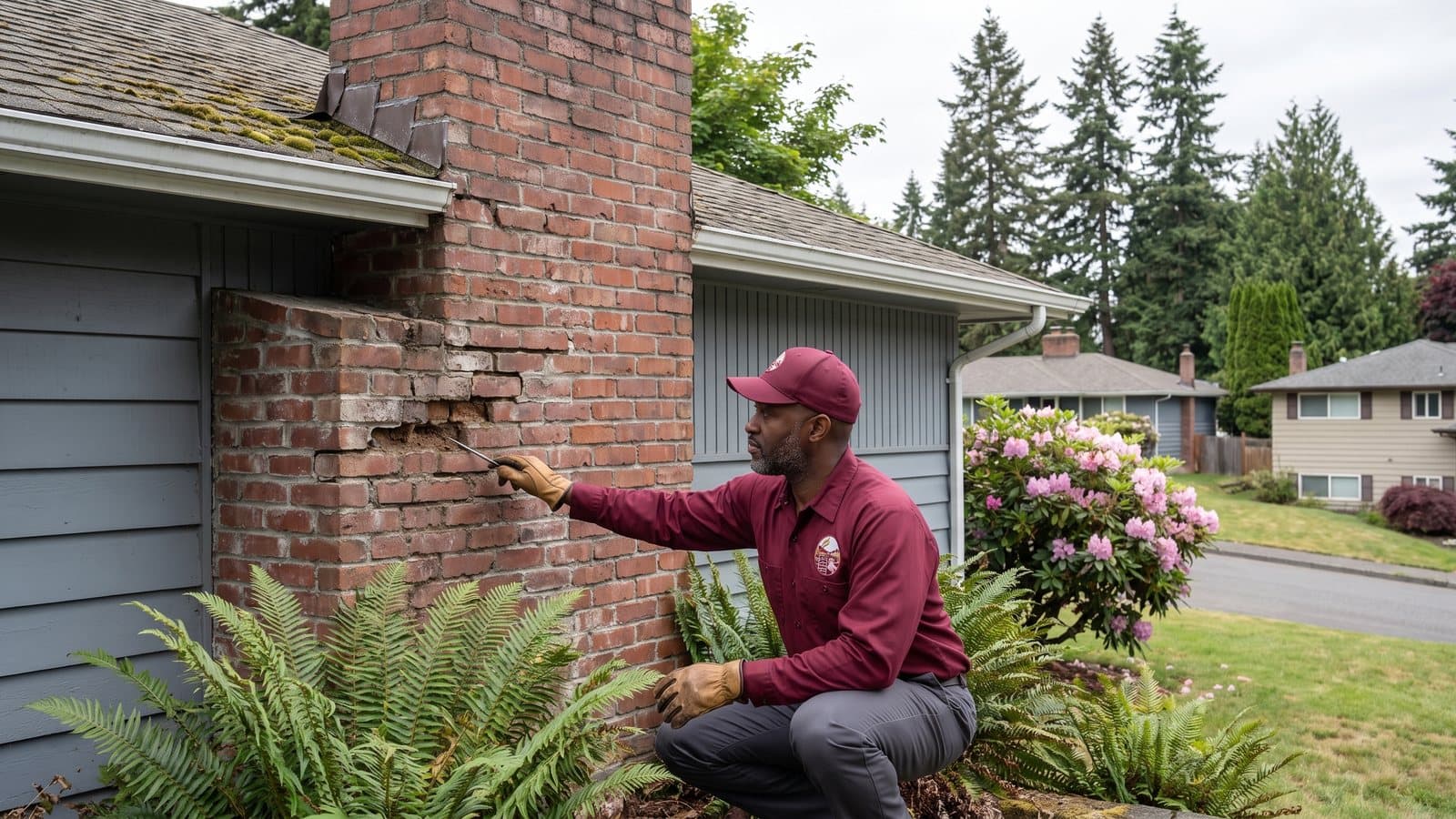
When a tile cracks or a joint washes out, all three jobs fail at that spot. Heat reaches brick that was never meant to face it, exhaust seeps into the shell, and the draft weakens.
Five findings that lead to a reline
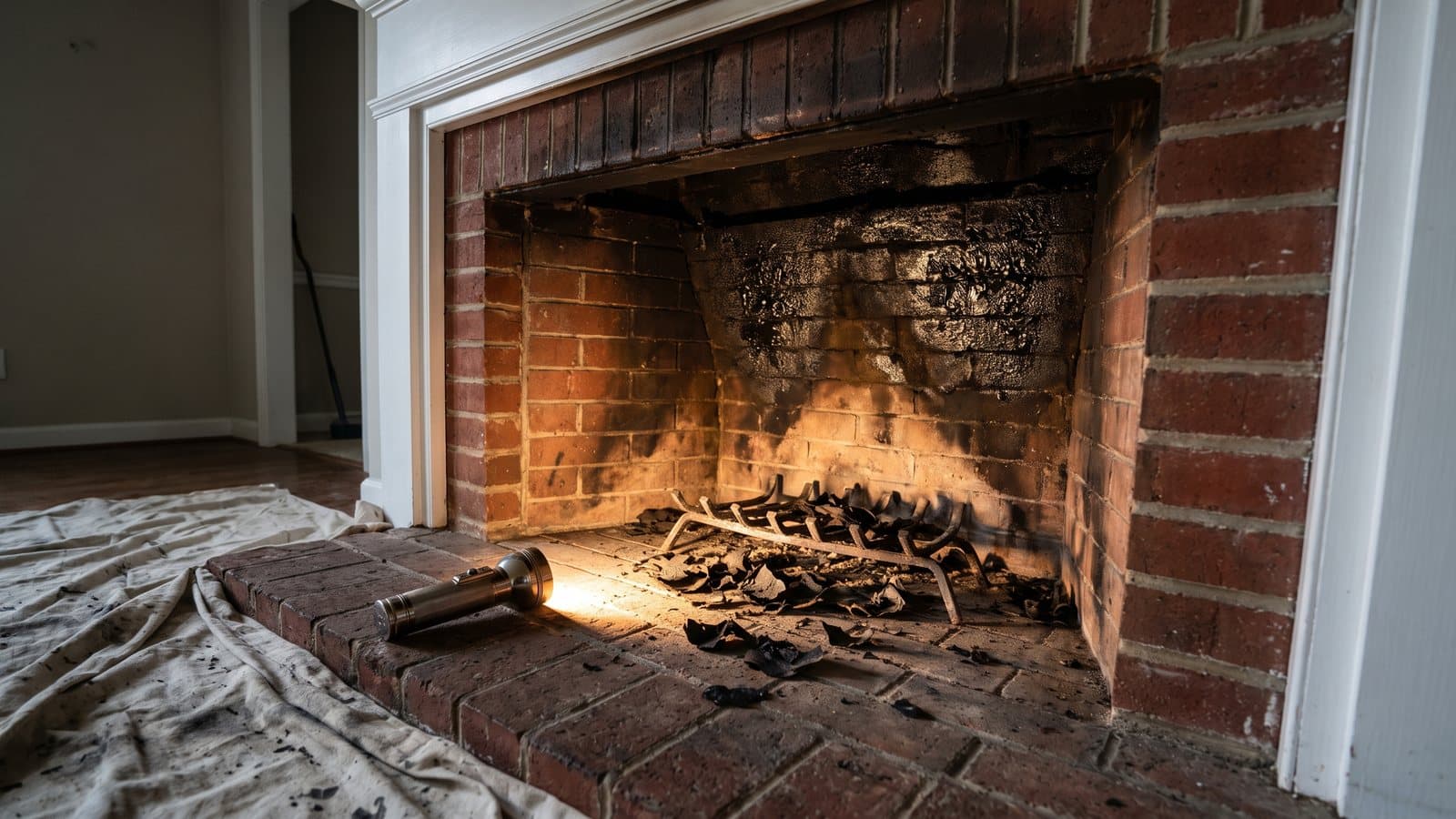
Nearly every reline starts with one of the findings in the table. None can be confirmed by looking up from the hearth with a flashlight, which is why the decision rests on a recorded scan of the whole flue.
One hairline crack in one tile does not put a chimney in the same category as a flue with missing joints from top to bottom. The scan shows where each defect sits and how many there are. The quote follows from that.
| What the scan or the sweep finds | What it tells us | Usual answer |
|---|---|---|
| Cracked or split clay tiles | Heat or movement has broken the flue wall | New liner through the full height |
| Open or eroded joints between tiles | Exhaust and moisture are reaching the brick shell | New liner, or joint repair if the tiles are sound |
| Tile flakes in the firebox | The inner face of the tiles is shedding | Camera scan, then usually a liner |
| No liner at all | An older flue built as bare brick | Liner before the next fire |
| New insert, stove or gas appliance on an old flue | The flue is now too large for what it serves | Liner sized to the appliance |
Why Renton has so many candidates
Liners fail with age, with water and with movement, and Renton's housing gives all three time to work. Census estimates for 2020 to 2024 place the median Renton home in 1988, but that middle figure hides a large older stock: about 39 percent of the city's 42,551 housing units went up before 1980 and about 14.5 percent before 1960. Counted by decade, some 15,310 units date from the 1940s through the 1970s, more than a third of the city. The medians in Newcastle, Snoqualmie and Maple Valley are 1999, 2005 and 2001.
Then there is the ground. In 2001 the Nisqually earthquake, a magnitude 6.8 event, shook Renton hard enough that the city's hazard annex still lists the result: "primarily cracked masonry and collapsed chimneys". U.S. Geological Survey teams who went through the wider region afterward, one block at a time, examined roughly 60,000 chimneys and found 1,556 damaged. A stack that stayed upright that morning may still carry a broken tile inside a shell that looks intact from the yard. Nor is the risk behind us: over the coming 50 years, the state Department of Natural Resources estimates at 85 percent the odds of a deep earthquake reaching at least magnitude 6.5 somewhere under the Puget Sound region.
Water is the third factor. The same annex counts 154 days with precipitation in an average Renton year. A flue with no cap, or with a cracked crown above it, takes that water straight down the tiles, and wet mortar joints erode faster than dry ones.
Liner types in plain terms
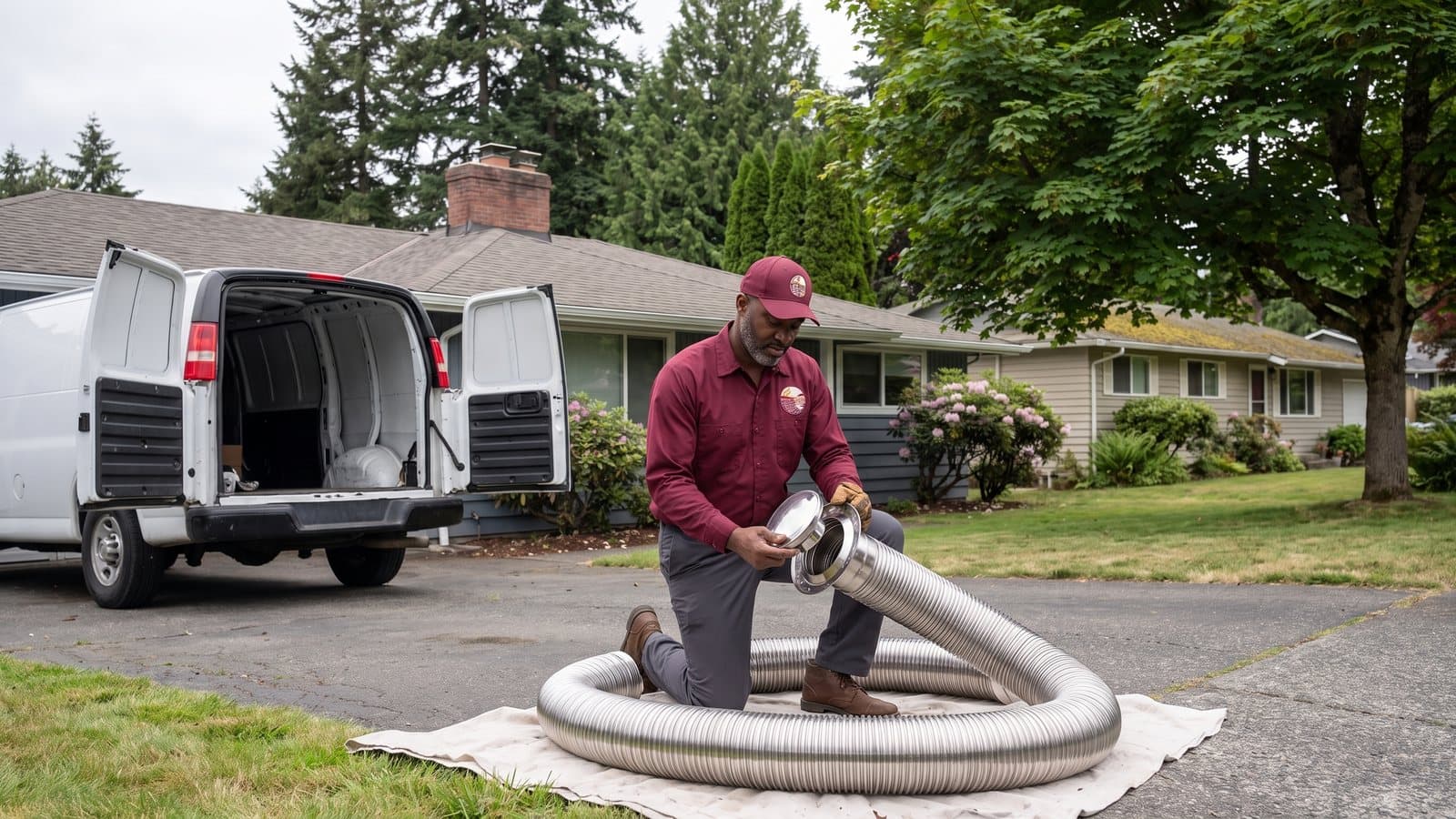
Stainless steel. A continuous metal tube, rigid for a straight flue and flexible for one with offsets, is lowered from the top and joined at the bottom to the fireplace throat, the insert or the stove. Insulation goes around it where the appliance calls for it. Most wood-burning relines we do use this method, because it works in a flue whose tiles are past saving and it can be sized exactly to the appliance.
Cast-in-place. A cement-like mix is formed against the inside of the old flue, which produces a new seamless wall and also stiffens a tired chimney. It suits some older structures and takes more labor.
Aluminum. Light-gauge aluminum liners exist for certain gas appliances only. They are never used with wood.
New clay tiles. Breaking out the damaged tiles and setting new ones is possible when a short section has failed and the flue runs straight. In a tall or offset chimney it is rarely the practical choice.
Which of the four fits depends on the fuel, the appliance, the height and the route the flue takes.
Outside the city limits, the county issues the permit
Plenty of homes with a Renton mailing address are not in the city. Fairwood is the best-known case: King County lists it as urban unincorporated land, since voters there turned down annexation to Renton in November 2010, and county rules apply. For unincorporated addresses the county's permitting handout says a residential mechanical permit is needed whenever a wood stove or a fireplace is installed, replaced or moved; the application is filed online at MyBuildingPermit.com. Gas log inserts are on the exempt list for single-family houses, although its gas piping can call for a separate permit. When a reline goes with a new stove or insert, we confirm which office has jurisdiction over your address before the quote is written.
Our figures, and one national reference
Relining with us starts at $1,900. A tall chimney, a flue with offsets, an insulated liner or a second flue in the same stack moves the figure upward, and the top of our range is $5,900. For context only: Fixr's guide gives $1,800 to $4,000 for liner installation nationally. That is a countrywide span, not a Renton quote and not ours.
Every reline begins with the inspection visit, billed $99 plus tax per chimney, camera scan included when the flue calls for one. Once you sign off on the reline, that $99 is taken off what the work comes to.
Frequently asked questions
Is it safe to burn until the liner is replaced?
Not when the scan shows open joints, missing tiles or a flue with no liner. With any of those, heat and exhaust get through to the brick shell and to the wood framing beside it. If the finding is minor and confined to one spot, the report says so and tells you whether burning can continue in the meantime.
How long does a reline take?
A stainless liner in a straight, single-flue chimney is commonly finished in a day. Offsets, a smoke chamber that has to be reshaped or a cast-in-place liner add time. The written quote gives the expected duration for your chimney, not a generic one.
Does a gas appliance need a liner too?
Often it does. Exhaust from a gas burner leaves cooler than wood smoke and carries a lot of water. In a masonry flue far too wide for it, that water condenses on the tiles and slowly dissolves the joints. About 40 percent of occupied Renton homes heat mainly with utility gas, by the Census estimates. Where a furnace or water heater vents into an old brick chimney, a liner matched to the appliance keeps the exhaust warm enough to leave the house.
Will a new liner change how the fireplace looks or draws?
The opening you see stays the same. Inside, a round steel liner has a little less cross-section than the square tiles around it, so we measure the fireplace opening against the liner size before ordering anything. When the two are a tight match, we explain the choices, which can include an oval liner or a smoke guard along the top of the opening.
Sources
- Census Reporter — ACS 2020–2024, tables B25034/B25035 — accessed October 4, 2026
- Census Reporter — ACS table B25040, heating fuel — accessed October 4, 2026
- City of Renton hazard mitigation annex — accessed October 4, 2026
- USGS — Nisqually chimney damage survey (2001) — accessed October 4, 2026
- Washington DNR — earthquakes and faults — accessed October 4, 2026
- King County — residential mechanical permits (May 2025) — accessed October 4, 2026
- King County — Fairwood annexation area page — accessed October 4, 2026
- Fixr — liner installation guide (national) — accessed October 4, 2026
Related services