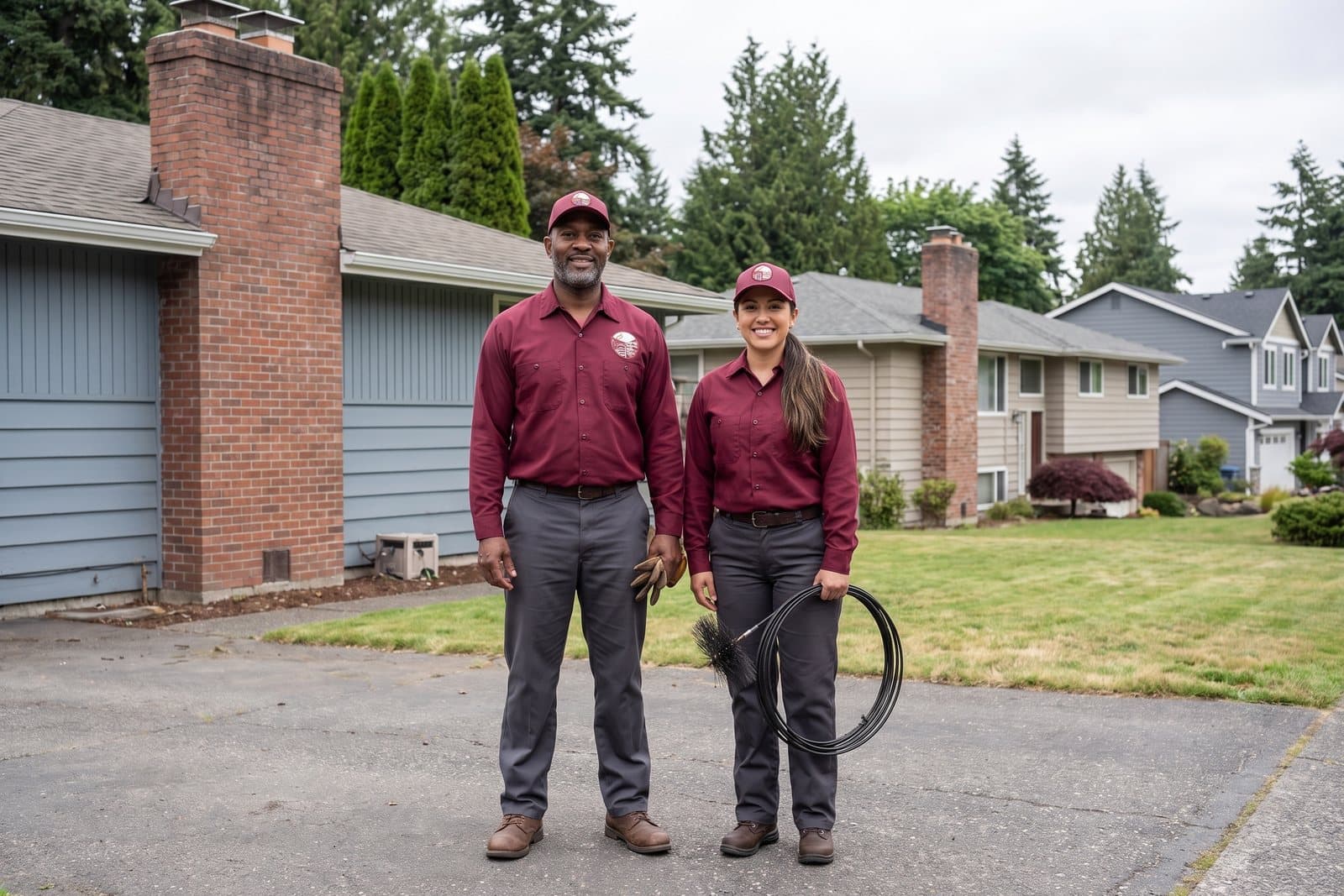
Chimney safety
A fireplace, stove or insert is safe when three things hold: the flue is clean, the structure is sound and the smoke goes where the rules allow. This guide walks through each one for southeast King County, and names the source behind every figure.
The Washington State Fire Marshal published its home heating figures on September 21, 2026. Citing the U.S. Fire Administration, it reports that fires in chimneys, flues or fuel burners caused 77% of all heating fires recorded in residential buildings during 2024. Washington fire agencies recorded 6 deaths from home heating sources the year before. The Fire Marshal's advice is short: have a professional inspect and clean the system annually, and fit the chimney with a cap.
Local conditions decide where the wear shows. Renton has the oldest houses of our four cities: the Census dates its median home to 1988 and counts about 36% of its housing from the 1940s through the 1970s. Snoqualmie's median home dates from 2005, Maple Valley's from 2001 and Newcastle's from 1999. Rain climbs from the lake toward the foothills, the ground can shake, and one agency decides when wood may burn.
Once a year
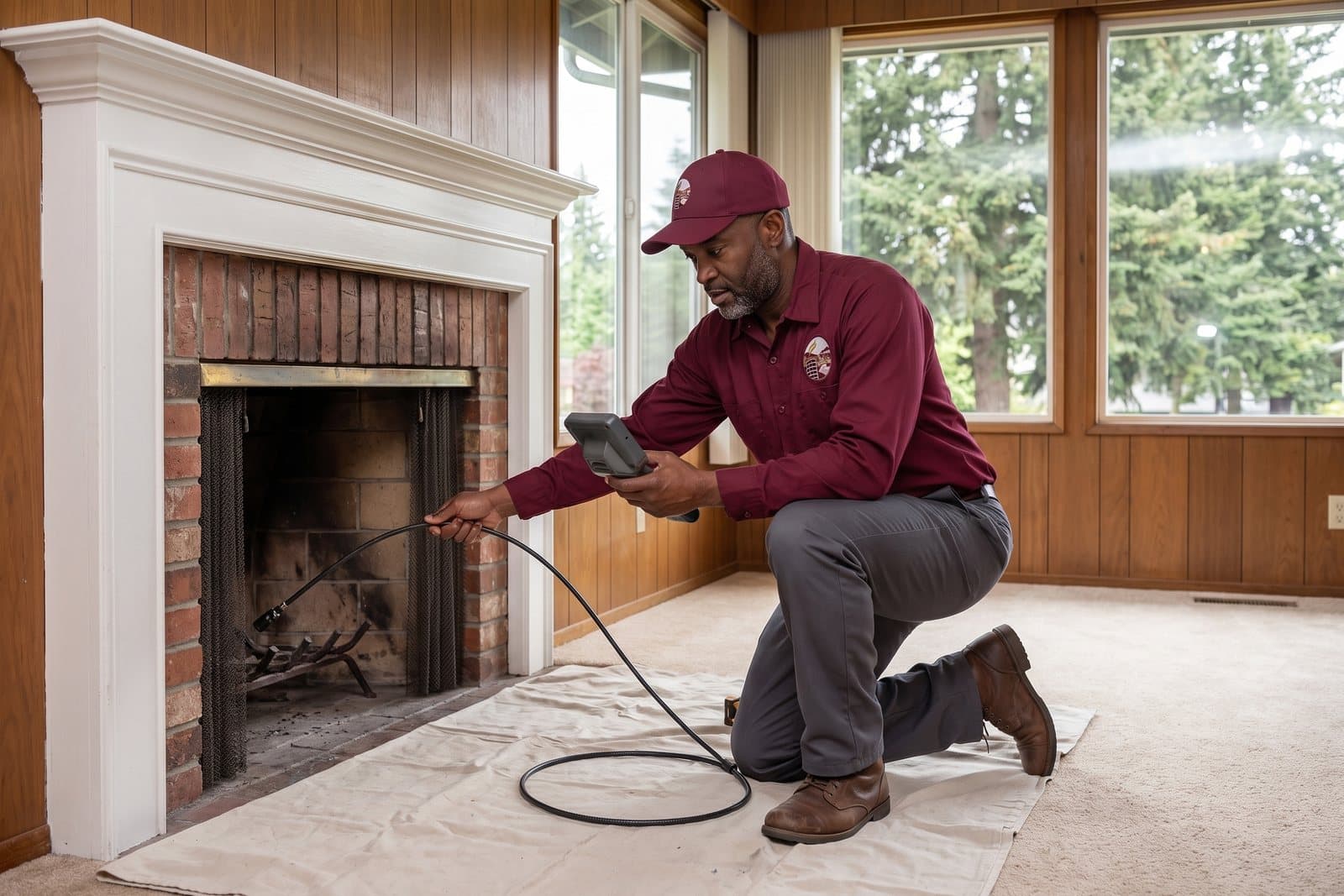
The national standard for chimneys is NFPA 211. The Chimney Safety Institute of America quotes its inspection sentence on a public page: every chimney, fireplace and vent is to be inspected no less than yearly, and the inspection looks for three things: soundness, absence of deposits, proper clearances.
Those are the questions a chimney inspection answers, from the firebox and from the roof. The dry months suit it best. WeatherSpark dates Renton's clearer skies from around June 15 to around October 8.
The fuel of a chimney fire
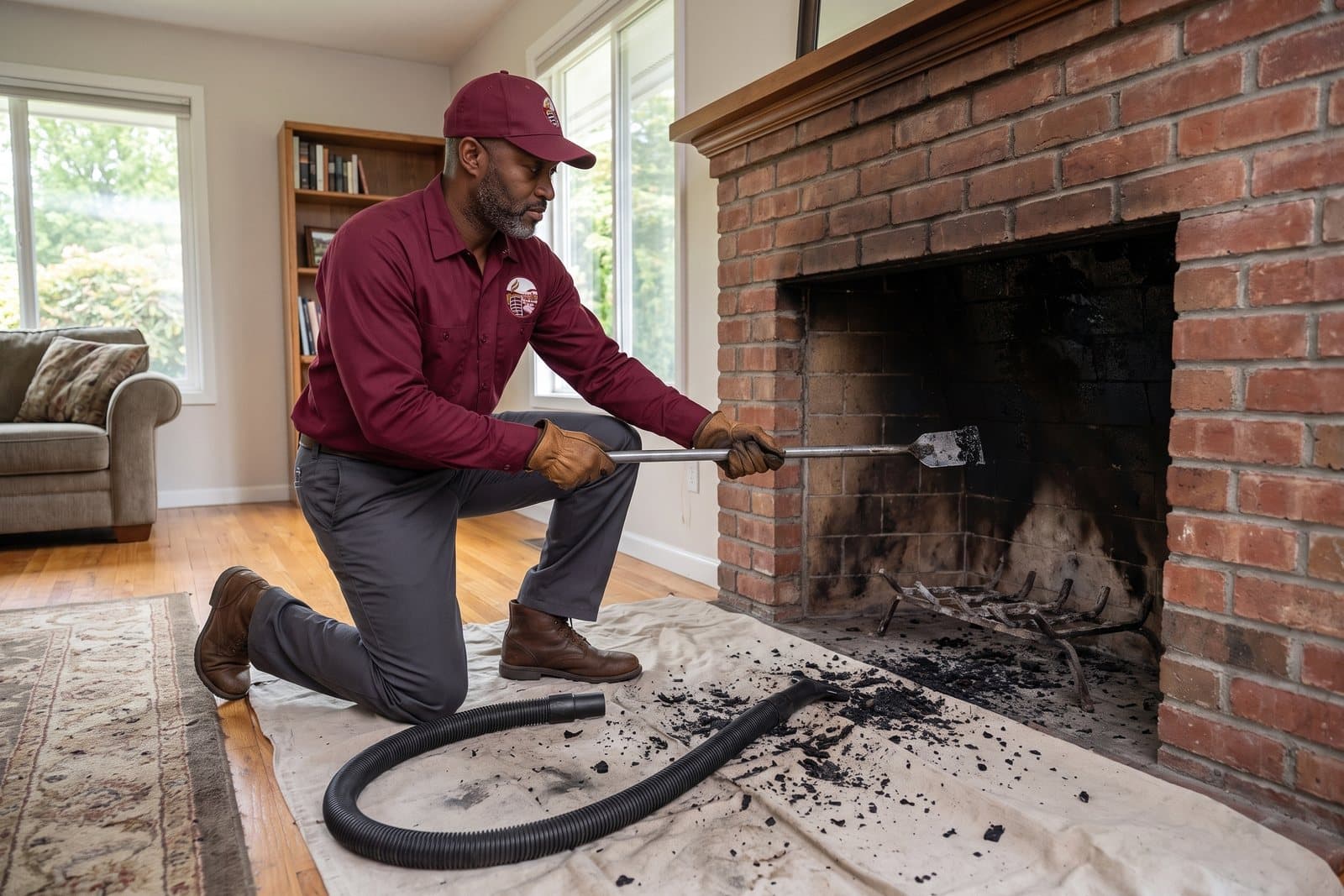
Every wood fire leaves creosote on the flue walls, and creosote burns. CSIA gives a threshold for a masonry fireplace: sweep as soon as soot has built up to 1/8 inch, and do not wait that long if glaze is present. A routine chimney sweep handles soot and flakes. Glaze calls for creosote removal, which is slower work.
What goes on the fire matters as much as how often it is cleaned. Two fuels pass the Clean Air Agency's test: seasoned firewood that has dried out, and manufactured logs. Under WAC 173-433-120 the firebox is no place for garbage, treated wood, plastics or rubber, nor for asphaltic or waste petroleum products, paint or chemicals.
Clean air rules
For King County, the power to declare an air quality burn ban sits with the Puget Sound Clean Air Agency. A ban therefore applies at once in Renton, Newcastle, Snoqualmie, Maple Valley and the unincorporated land between them. For King County, a Stage 1 ban comes when stagnant weather is forecast to push fine particles above a 24-hour average of 35 micrograms per cubic meter within 48 hours.
A single carve-out covers the home that has no adequate heat apart from its wood-burning device. The household must apply for the exemption the agency names "No Other Adequate Source of Heat" and be approved before it burns during a ban. Inspectors trained to read smoke opacity write the property's owner a Notice of Violation when they see a ban broken, and under WAC 173-433-150 a ban can be enforced three hours after it is declared.
A second rule never switches off. On any day of the year, the smoke a chimney gives off has a ceiling of 20 percent opacity, and six straight minutes over it within an hour is a violation. Bans themselves usually last a few days in fall or winter. Today's status is on the agency's website with a map, and by phone at 800-595-4341.
Wood, pellets and gas all produce carbon monoxide as they burn, and it has no color or smell. The flue or vent is what carries it out of the house. A working alarm on each floor is the only warning you will get if that path fails.
Gas and wood, by the numbers
Census estimates show how homes here are heated. Utility gas is the main fuel for 40.5% of Renton's occupied homes and 45.7% of Newcastle's; the share rises to 59.0% for Maple Valley and 64.5% for Snoqualmie. Few homes in the four cities report wood as their main heat, and noticeably more do on rural lots such as the Hobart area beside Maple Valley. The Census does not count fireplaces, so these figures say nothing about how many homes have one for evenings. Whatever the fuel, the weak points are the same: a vent joint that has slipped, a missing cap that lets birds nest, or a liner that no longer matches the appliance below it. If a carbon monoxide alarm sounds, get everyone out first and make the call from the street.
Water, then cold
Long weather records show the slope. The Western Regional Climate Center's stations averaged about 38 inches of precipitation a year at Kent, in the valley south of Renton, 56 inches at Landsburg on the Cedar River and 59 inches at Snoqualmie Falls. Freezing nights follow the same climb, from about 60 a year at Kent to about 80 at Landsburg.
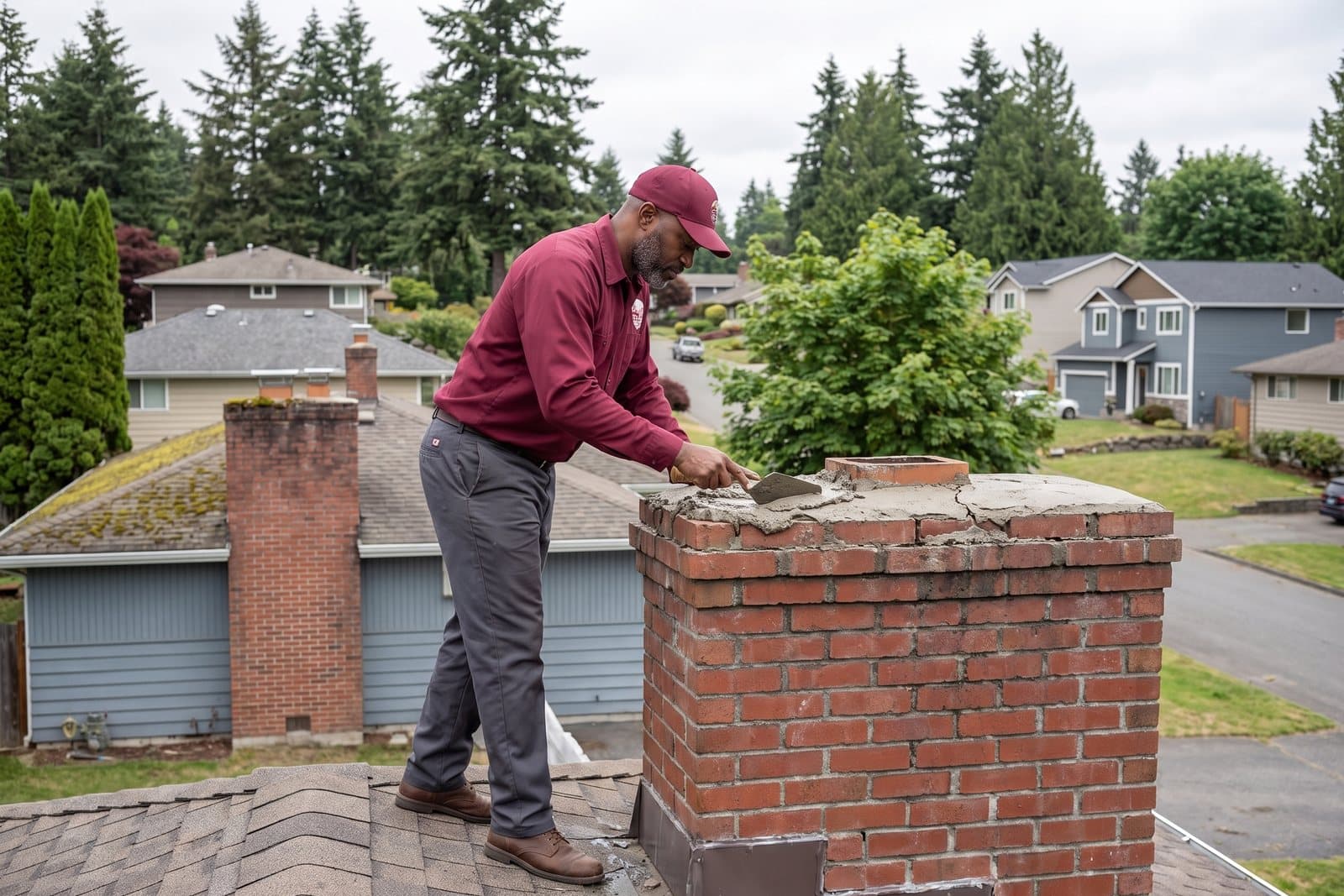
Wet brick that then freezes is what breaks masonry. Renton's hazard annex expects a few days of freezing weather in an ordinary winter and calls long, hard freezes rare. Masonry repair deals with the crown and the joints once they open; waterproofing keeps sound brick from soaking up the next storm.
Wetter season from October 9 to May 2, about 6.8 months. November is the peak at roughly 8.0 inches of rain over some 17 wet days. The cool season runs November 13 to February 28, and a short snowy period falls between December 10 and January 25.
Same wet-season dates as Renton, with a touch more November rain, about 8.3 inches. Snow lingers a little longer on the hills: the snowy period runs December 4 to January 31, and January averages about 1.9 inches.
The wetter season stretches to May 17, about 7.3 months, and November brings around 8.9 inches. The snowy period lasts about two months, December 4 to February 6. At the Landsburg station nearby, the low reached freezing on about 80 days a year.
The longest wet season of the four, October 7 to May 31, with about 9.8 inches of rain in November. Its snowy period, November 27 to February 16, is also the longest. The Snoqualmie Falls station recorded a freezing low on 64.5 days a year.
City figures are WeatherSpark's modelled averages; station figures are WRCC records that end in the 2010s. Neither gives a count of freeze-thaw cycles, so none is quoted.
Earthquakes
Renton's hazard annex is plain about it. The city is exposed to a major earthquake from the Seattle fault zone to its north and from the Cascadia Subduction Zone offshore, and many of its homes were built before seismic codes took the risk into account. The annex describes what the 2001 Nisqually earthquake, magnitude 6.8, did in Renton as "primarily cracked masonry and collapsed chimneys".
The U.S. Geological Survey measured the same event across the region. Its researchers covered about 50 square kilometers block by block, surveyed approximately 60,000 chimneys and identified 1,556 damaged ones. Their study notes that unreinforced brick chimneys had also been damaged in 1949 and 1965. Looking ahead, the state geological survey at DNR puts the odds of a deep quake of at least magnitude 6.5 striking the Puget Sound region in the next 50 years at 85%.
The state residential code answers with steel. Three Seismic Design Categories trigger it (D0, D1, D2): there, a masonry chimney must be reinforced and anchored at each floor, ceiling or roof line more than 6 feet above grade. We did not find the category for Renton, Newcastle, Snoqualmie, Maple Valley or county addresses on a page you can open yourself, so your building department is the place to ask which one covers your street. Newcastle's annex does say three active faults of that same zone run through its territory. After any quake you feel, a chimney repair visit starts with a look at the stack above the roof and the flue inside it.
Above the shingles
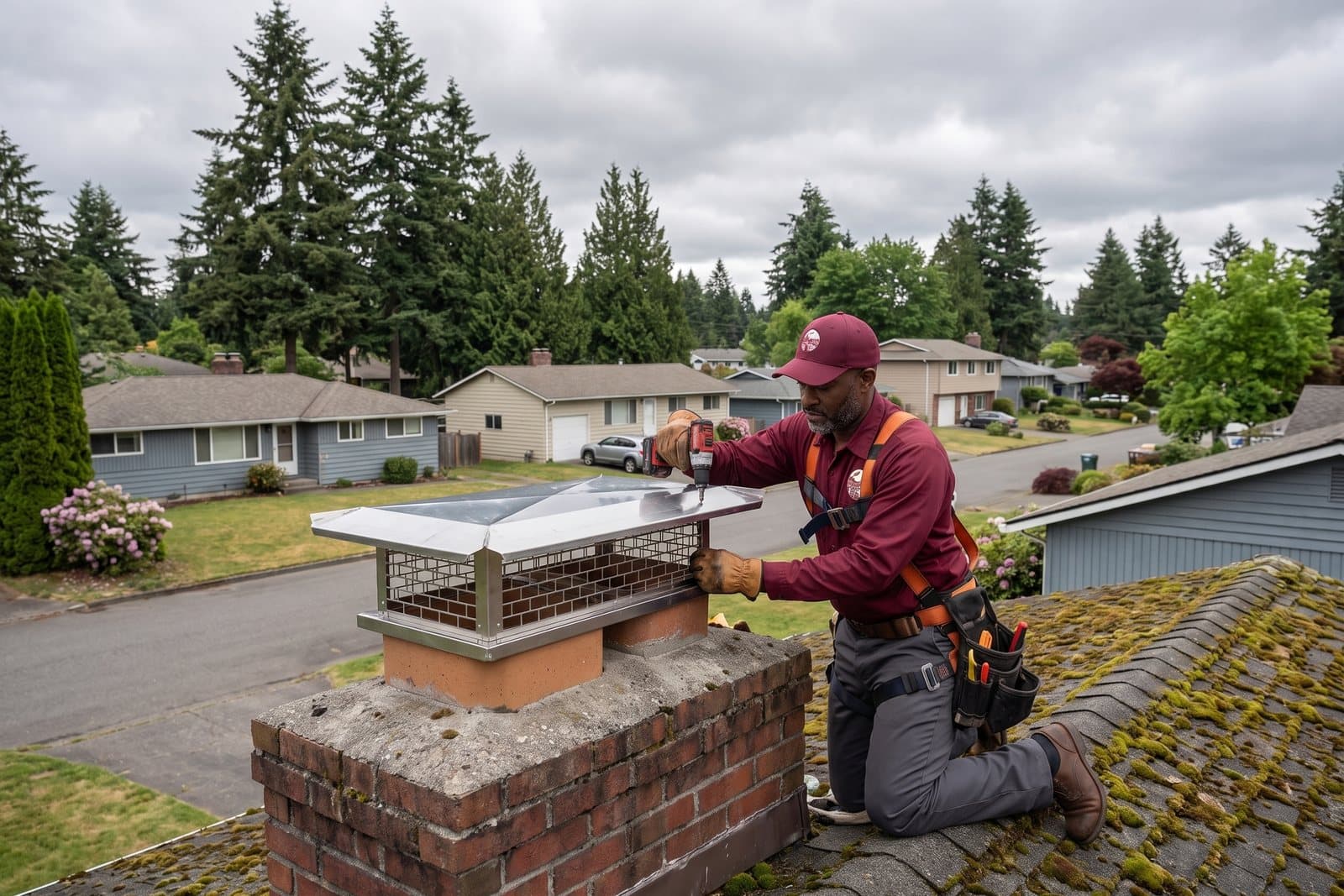
Those four lines come from the 2021 Washington State Residential Code. A chimney cap is also one of the two things the State Fire Marshal asks every homeowner for. Where the chimney meets the roof, flashing is what keeps rain out of the attic.
Wind tests all of it. Renton's annex says trees frequently fall in seasonal storms and that some neighborhoods sit entirely within stands of tall trees. Newcastle's reports tree-felling wind events every couple of years, and Snoqualmie's places the highest windstorm risk in October and November. Shade brings moss, which Oregon State University Extension calls inevitable on roofs in the moist Northwest; its lasting fix is trimming nearby trees so sunlight reaches the roof.
At the hearth
The code sets the room side of a masonry fireplace in inches. The hearth extension reaches at least 16 inches in front of the opening and 8 inches past each side, or 20 and 12 inches when the opening is 6 square feet or larger. Wood framing stays 2 inches clear of the front and sides of the fireplace and 4 inches clear of its back. A combustible mantel or trim may not sit within 6 inches of the opening.
Washington adds two requirements of its own in WAC 51-51-1001: a damper of ferrous metal set 8 inches or more above the fireplace opening's top edge, and combustion air ducted into the firebox from outside, with an operable damper on that duct. Ashes deserve the same caution as the fire: they go into a lidded metal can that stays outdoors, away from the deck and the siding.
The other vent
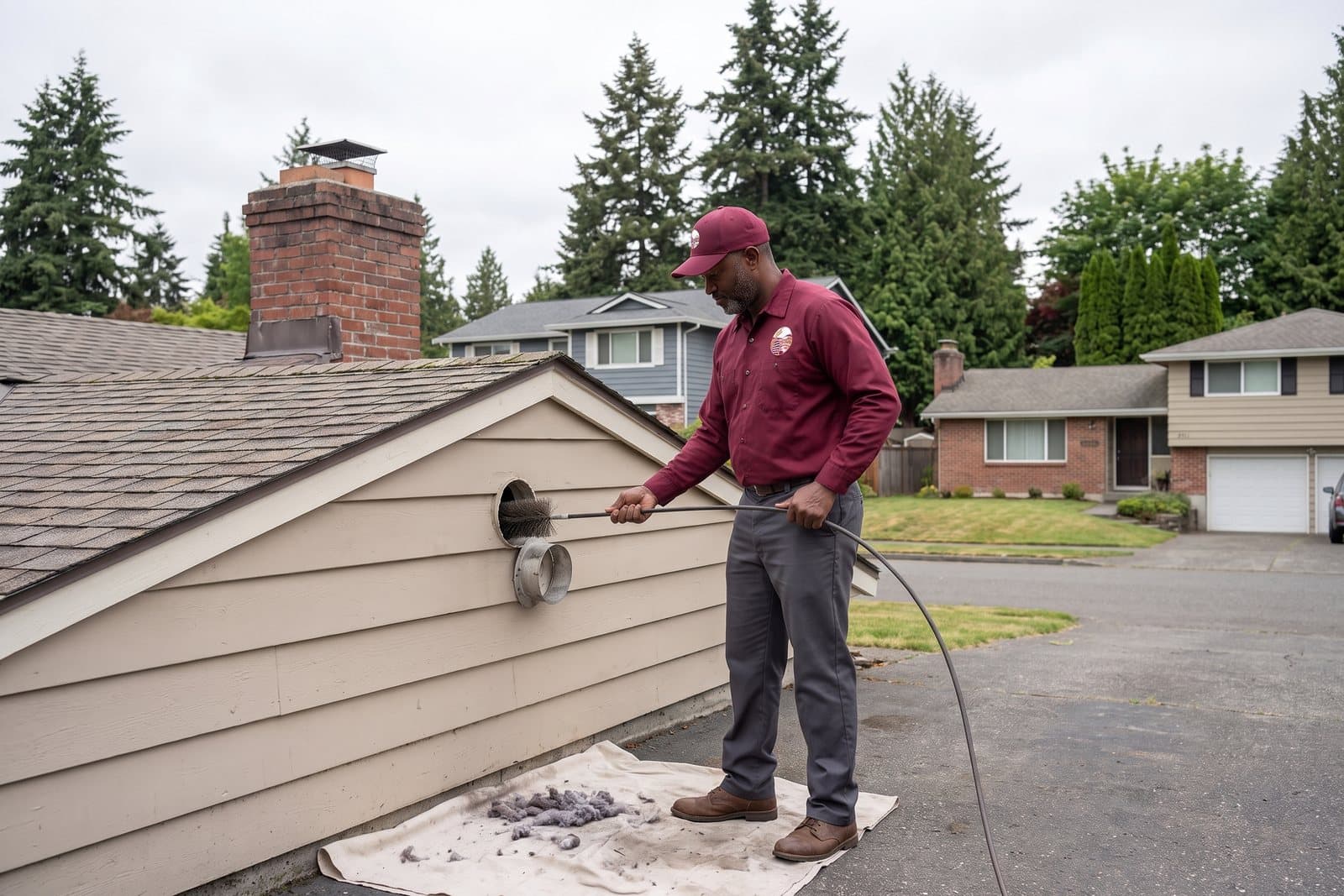
National figures from the U.S. Fire Administration put clothes dryer fires in residential buildings at about 2,900 a year, with roughly 5 deaths and 100 injuries. The leading factor it identifies is simple: failure to clean, in 34 percent of cases. Those fires peak in January.
The bullet list is the state code's rule for a dryer exhaust duct. Dryer vent cleaning clears the full run, and tells you whether the duct you have meets that description.
Summer smoke
Wildfire smoke is a summer problem, and a growing one. The Clean Air Agency expects more wildfires, and potentially more smoke reaching the Puget Sound region, as the climate changes. The county's public health agency warns that a plume may foul the air for anything from a few days to weeks. Years differ: the agency reports that the region was not affected by wildfire smoke in 2024, while in 2026 a wildfire emergency declared by the Governor on August 1 put a stop to most outdoor burning statewide until September 30.
Winter has its own smoke, and it comes from chimneys. In 2024 the agency counted up to 4 winter days on which home-heating wood smoke lifted fine particles over the 25-microgram-per-cubic-meter goal it sets for health. An open flue is a hole in the house either way, so a damper that shuts tight and a cap in good order are worth checking before August.
Permits
The 2021 Washington State building codes took effect on March 15, 2024. The permit itself is local: each city runs its own desk, and King County handles every address outside city limits.
The city requires a permit before a gas or mechanical system is installed, altered, repaired or replaced, apart from a list of exemptions. Its permit FAQ says mechanical and re-roof permits are simple over-the-counter permits that can be requested online on the Civic Access Self-Service Portal. The FAQ never names fireplaces, stoves or inserts, so check your job with the permit desk.
Newcastle switched its permit intake to OpenGov in June 2026. None of the city pages opened for this guide says which fireplace, stove or chimney work needs a permit, so the question goes to the city before the job is booked.
The city's 'Do I Need a Permit?' page requires one whenever a mechanical appliance is put in, moved or swapped, and gives fireplaces and stoves as examples; a reroof needs one as well. Mechanical permits can be filed through MyBuildingPermit, and the city says reviews typically take 4 to 6 weeks.
No Maple Valley page listing the work that needs a permit could be opened for this guide, so no rule is stated here. Ask the city's permit staff before an appliance is installed or replaced.
Fairwood, East Renton Highlands, Hobart and the rural land around the four cities fall under the county. A wood stove or fireplace that is installed, replaced or relocated there needs the county's residential mechanical permit. A gas log insert in a single-family house is exempted, though gas piping may need its own permit. Applications are made on MyBuildingPermit.com.
Fairwood is a common mix-up. King County lists it as unincorporated: a 2010 ballot measure to join Renton failed, so county permits apply there.
Who does what
A safe season is mostly routine. Some of it happens at the hearth every evening, and some of it needs a ladder, a camera or a gas gauge.
August and September
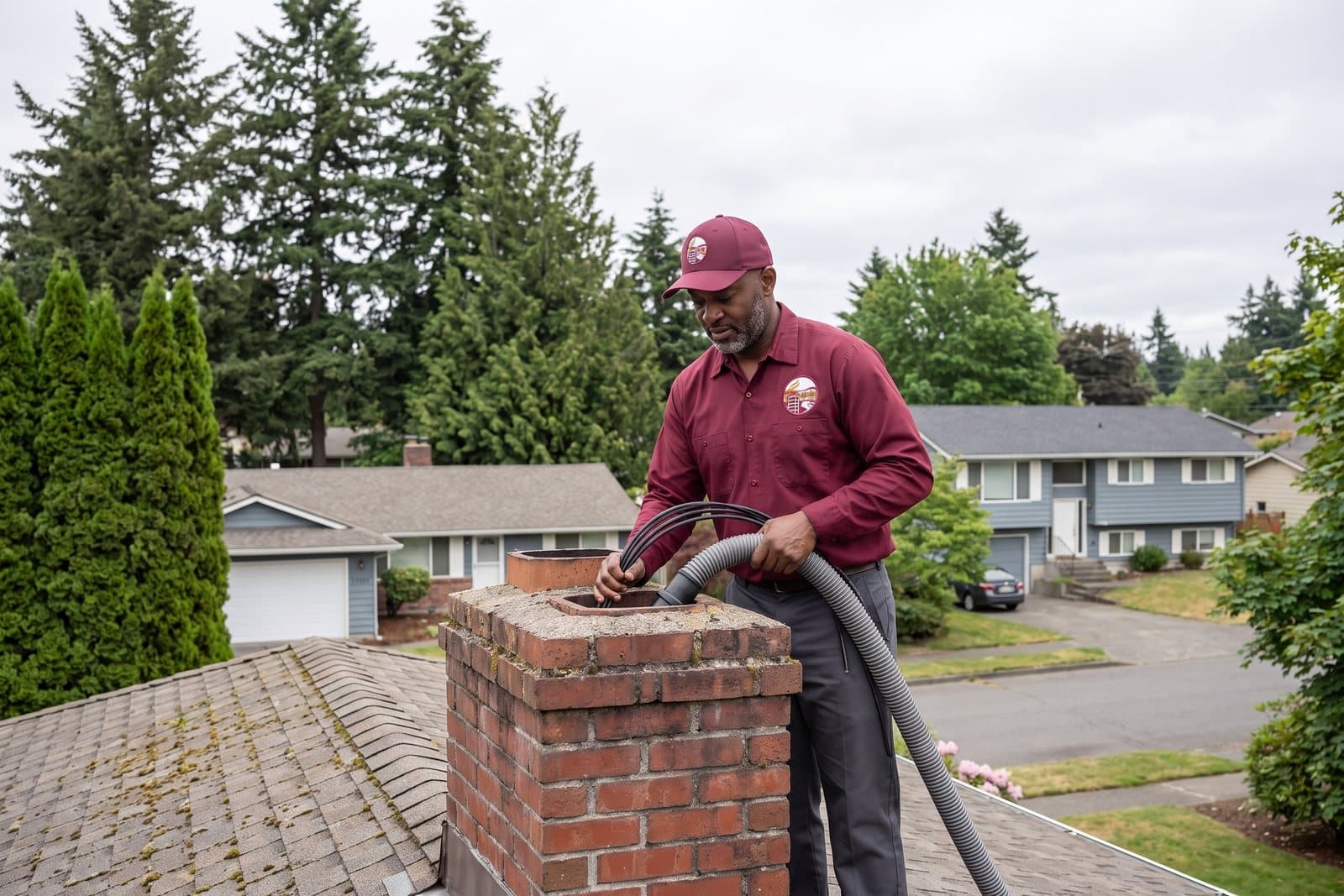
Renton's wetter season opens around October 9. A visit before then means any repair happens on a dry roof.
The report gives the depth of the deposits. At 1/8 inch of soot, or with glaze of any thickness, the flue gets cleaned.
Is the cap straight and still there? Anything green growing on the crown? Stains running down the brick?
Fewer limbs above the chimney means less to fall in an October windstorm and more sun on the shingles.
The Clean Air Agency's status line is 800-595-4341. Its website also takes sign-ups for alerts.
Keep reading
The blog takes one subject per article, from creosote stages to flashing leaks, and cites its sources the way this guide does.
Questions
Sources
All pages below were opened on October 4, 2026. NFPA 211 is sold, not published, so its inspection sentence is given as CSIA quotes it; the state residential code is read on UpCodes' copy.
A Renton Chimney Pros technician checks the chimney, takes photos and sends you a written report. The visit costs $99 plus tax, and that amount is deducted from the work when you approve the quote.