One eighth of an inch. That is the depth of sooty deposit at which the Chimney Safety Institute of America says a masonry fireplace flue should be swept, and sooner if any of the deposit has turned to glaze. Creosote is the reason for the rule. It is fuel, it collects in the one place a fire is never supposed to reach, and nearly everything that makes it collect faster is a habit the household controls. This guide covers what it is, how to recognize its three stages, and what slows it down in a Renton winter.
Smoke that did not make it out
Wood smoke is not only gas. It carries water vapor, unburned tar droplets and fine carbon. As the smoke climbs a flue it cools, and when it meets a surface colder than itself, part of that load condenses and sticks. The cooler the flue wall and the slower the smoke, the more is left behind.
The deposit burns. If a hot fire or a stray spark lights it, the result is a fire inside the flue, against a liner that was built to carry exhaust and not flames. The Washington State Fire Marshal put numbers on it in a September 2026 release. Drawing on U.S. Fire Administration data, it traces 77 percent of 2024's heating fires in residential buildings back to three places: chimneys, flues and fuel burners, and it counts 6 people killed in Washington the previous year by fires that began with home heating.
Three stages, three different jobs
Sweeps sort creosote into three stages by how it looks and how hard it is to remove. The stage, more than the quantity, decides what the cleaning involves.
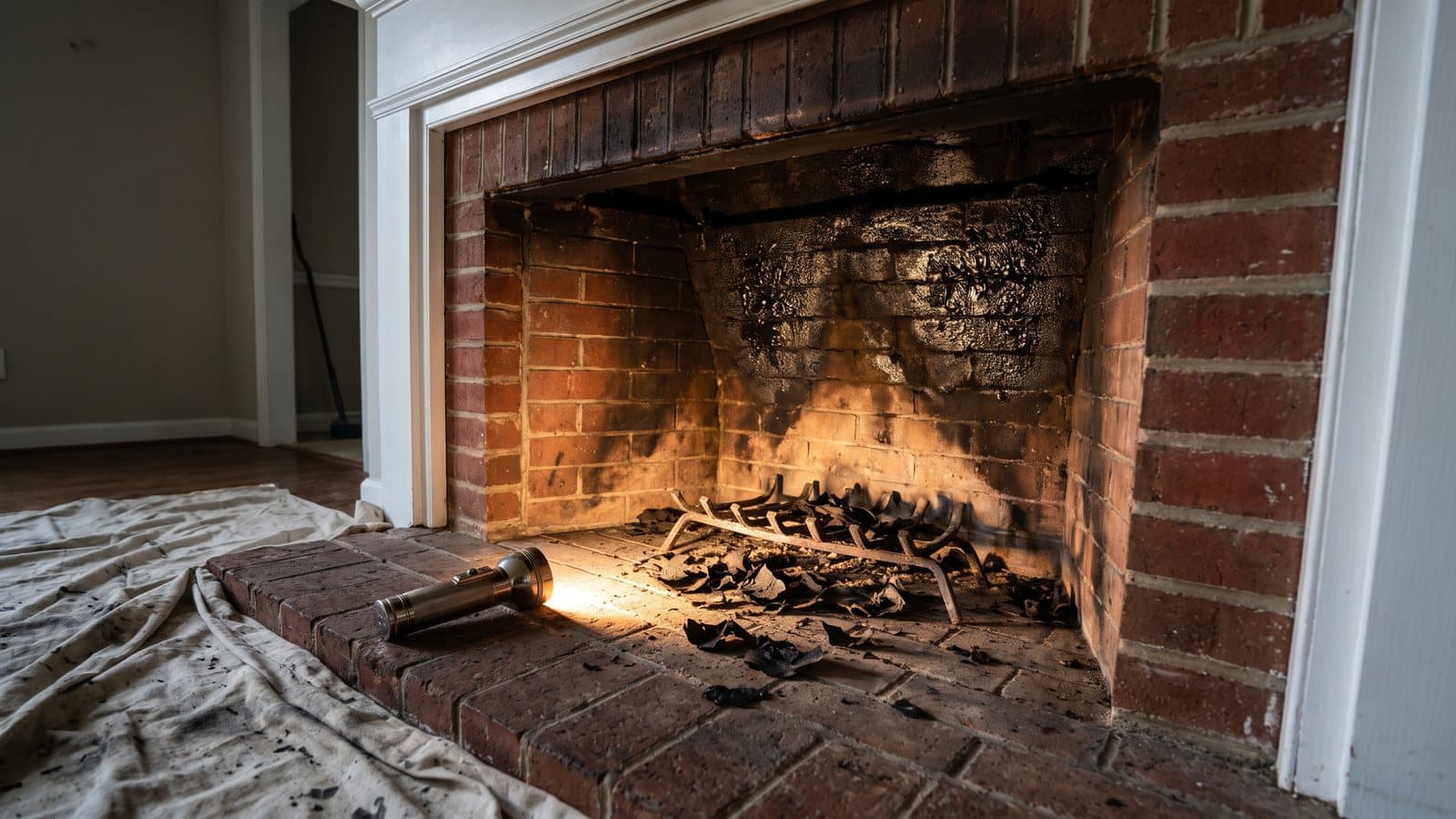
Stage three is the one to avoid. It forms when deposits are baked repeatedly without being removed, and a brush slides over it. Getting it off takes rotary tools or a chemical treatment applied over more than one visit, and sometimes the liner beneath turns out to be damaged.
| Stage | What it looks like | How it comes off |
|---|---|---|
| First | Loose, dull black soot, dusty to the touch | Standard brushing during a sweep |
| Second | Hard, shiny black flakes, like dried tar chips | Stiffer brushes or rotary tools; more time |
| Third | Thick glaze, glossy and dense, sometimes dripping | Rotary chains or chemical treatment, often several passes |
Four habits that feed it
Damp wood. Water in the log has to boil off before the wood can burn, and that steam cools the smoke. Keeping firewood dry takes effort here: western Washington's January air holds about 87 percent relative humidity at 4 a.m. and still 78 percent at 4 p.m., the Western Regional Climate Center reports, and Renton's hazard annex counts 154 days with precipitation a year. Wood stacked uncovered against a fence in October will not dry over a winter like that. Split it, stack it off the ground, cover the top and leave the sides open.
Starved fires. Closing the air control or the glass doors to make a load last all evening produces a slow, smoky burn. A smaller, brighter fire deposits less than a large smoldering one.
A cold, oversized flue. An exterior chimney on a north wall, or an insert venting into a big masonry flue without a liner of its own, never gets warm enough to carry the smoke out before it condenses. This is a construction issue, and the fix is a correctly sized liner.
Skipped years. First-stage soot left in place is what the next season's fires bake into the second stage.
What local air rules already ask
The habits that reduce creosote are close to the ones the Puget Sound Clean Air Agency enforces for air quality. Under the agency's rules, in force across King County, two fuels are allowed and no others: seasoned firewood that has had time to dry, and manufactured logs. Garbage, plastics, paints, treated wood and the like are barred outright by a state rule, WAC 173-433-120. There is also a year-round smoke limit: opacity above 20 percent for six minutes running, within any one-hour period, is not permitted. Thick smoke from the chimney top is both a sign of a dirty burn and a violation.
The agency also calls air quality burn bans, typically in fall and winter and usually for a few days. A Stage 1 ban shuts down wood fireplaces, and with them every stove or insert lacking certification; the sole exception is a household with no other adequate way to heat and an exemption approved in advance. At Stage 2, certified stoves and pellet stoves are shut down as well. Look up the ban status on the agency's site before you light a fire on a still, cold evening.
Wood is the main heating fuel in few homes inside Renton, Newcastle or Snoqualmie, according to Census estimates, and in noticeably more on the rural lots toward Hobart. That count covers primary heat only. It says nothing of the many fireplaces lit on weekends, which is where we find most neglected flues.
If you think the chimney is on fire
A loud roar or rumble from the fireplace, dense smoke, sparks or flame from the chimney top, or a sudden intense heat at the wall are the signs. Get everyone out and call 911. If it can be done in a second without risk, close the stove's air control or the fireplace doors on the way out to cut the air supply. Do not go back in to deal with it.
Afterward, do not light another fire until the flue has been scanned. Clay tiles often crack in a chimney fire, and a cracked liner turns the next ordinary fire into a hazard for the framing around the chimney.
Sweep or removal, and what each runs
First-stage soot comes out in a standard sweep, which runs $189 to $459 with us depending on the appliance and the access. When the deposit has hardened into the second or third stage, the work is billed as creosote removal, starting at $245 and reaching $585 for heavy glaze. Housecall Pro's guide for the trade reports that heavy buildup adds $100 to $300 to a base cleaning nationally; that is an industry average, not our quote.
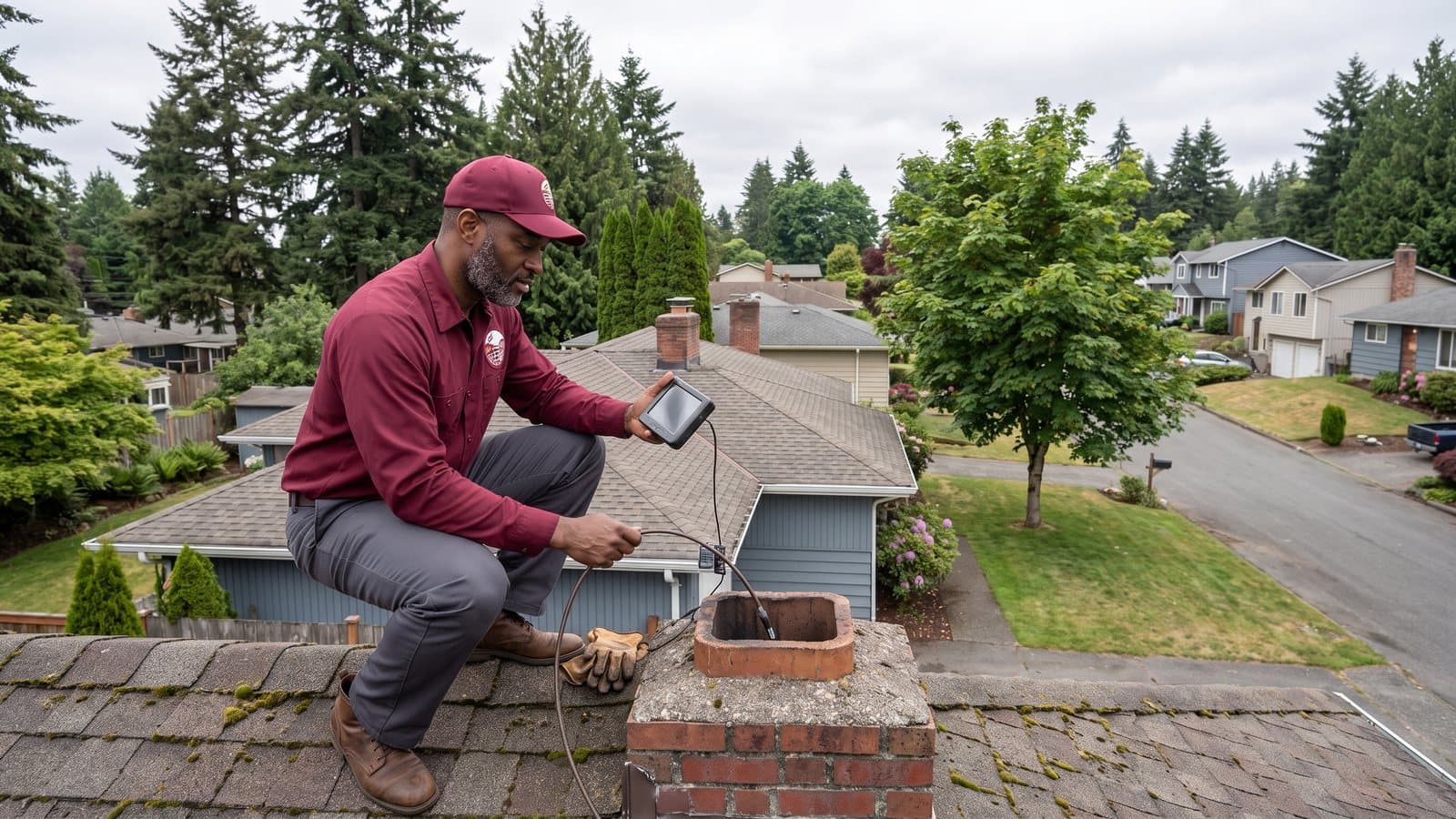
We cannot tell which job a flue needs from a phone call. A technician looks first: $99 plus tax for the visit, taken off the bill once you approve the quoted work.
Frequently asked questions
Do creosote sweeping logs replace a sweep?
No. A treated log can dry out some deposits and make them easier to brush off, which helps before a sweep. It does not carry the loosened material out of the flue, and it does nothing about a nest, a cracked tile or a blocked cap. Use one if you like, then have the chimney brushed and looked at.
I burn only a few fires a year. Can creosote still build up?
Yes, although slowly. Short, cool fires are the ones that deposit the most per hour, because the flue never warms up. NFPA 211, as CSIA quotes it, asks for an inspection every year whatever the use, and the sweeping follows from what the inspection measures.
Does a gas fireplace produce creosote?
Not in the way wood does. Gas burns without the tars that condense into creosote. A gas unit has its own maintenance needs, mainly the vent, the burner and the glass seal. If a gas log set was installed in a fireplace that burned wood for years, the old deposits are still in the flue and should come out.
How do I know my firewood is dry enough?
Dry wood is lighter than it looks, has cracks radiating across the cut ends and gives a sharp knock when two pieces are struck together. Wet wood hisses and bubbles at the ends in the fire. An inexpensive moisture meter pushed into a freshly split face settles the question; the supplier of the meter states the reading to aim for.
Is a chimney fire always obvious?
No. Some roar and throw sparks from the top. Others burn slowly with little noise and are discovered later, when a sweep finds puffy, ash-gray deposits or cracked tiles. Either kind can damage the liner, which is why a chimney is inspected after any suspected fire before it is used again.
Sources
- CSIA homeowner resources — NFPA 211 quoted — accessed October 4, 2026
- Washington State Fire Marshal — heating safety release — accessed October 4, 2026
- PSCAA — wood smoke legal overview — accessed October 4, 2026
- PSCAA — air quality burn bans explained — accessed October 4, 2026
- WAC 173-433-120 via Cornell LII — accessed October 4, 2026
- WRCC — Climate of Washington — accessed October 4, 2026
- Renton hazard annex (King County plan) — accessed October 4, 2026
- ACS B25040 heating fuel — Census Reporter — accessed October 4, 2026
- Housecall Pro — 2026 chimney cleaning guide — accessed October 4, 2026
Related services